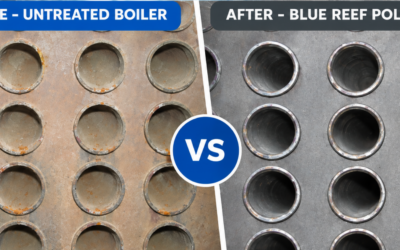
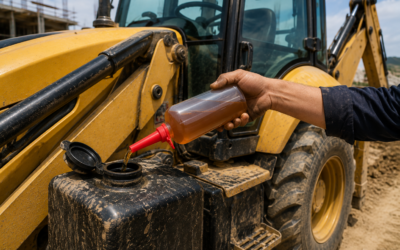
In South Africa, speciality chemicals are essential to preserving the longevity of industrial water systems. Boilers and cooling water systems, which are used in many industries, such as manufacturing, chemical processing, and power generation, are vulnerable to operational difficulties brought on by fouling and the buildup of unwanted materials.
Due to decreased heat transmission, higher energy usage, and unplanned downtime, fouling in industrial heat exchangers alone can cost South Africa billions of Rands every year. To mitigate these problems, effective water treatment processes that include specialised chemicals like antifoulants and dispersants are needed.
Blue Reef Water Solutions is a leading South African water treatment company that offers speciality chemicals and outsourced services for a range of industries. We create bespoke chemicals for various water treatment processes for boilers and cooling water systems, so how do antifoulants and dispersants help?

Antifoulants prevent surface deposition
Antifoulants are a class of specialised chemicals designed to stop or reduce the buildup of undesirable substances on heat transfer surfaces and other important parts of water systems. Some of the causes of this fouling include the deposition of suspended solids (silt, corrosion products), the proliferation of microorganisms (biofouling), and the precipitation of inorganic salts (scaling).
These deposits act as insulators, which lowers the efficiency of heat transfer in boilers and cooling towers, raising energy consumption and causing equipment failure or damage. Antifoulants prevent these deposits from forming through a few different methods.
One of the main ways antifoulants work is through crystal modification of the involved minerals. Some antifoulants disrupt the nucleation and growth of scale-forming crystals of minerals, especially those used to prevent scale formation. By adhering to the surface of developing crystals, these substances change their structure and stop them from growing into big, firmly packed mineral deposits on surfaces. Smaller, loosely bound crystals/mineral deposits form as a result, making it easier for the water flow to carry them away.
Threshold inhibition is another method that successfully prevents scale formation by interfering with the early phases of mineral crystal growth. Certain antifoulants work by chelating or sequestering metal ions, such as calcium and magnesium, to stop them from interacting with anions, such as carbonate and sulphate, to produce scale.
In addition, some antifoulants prevent corrosion and reduce the deposition of corrosion products by forming a protective coating on metal surfaces. Taking into account variables like water chemistry, temperature, and flow rates, the specific chemistry of an antifoulant is designed to match the specific forms of foulants likely to be present in the water system.

Dispersants maintain particle suspension in water
In water treatment, dispersants are another essential class of speciality chemicals, especially when it comes to controlling suspended particles in boiler and cooling water systems. Dispersants prevent the settling and formation of problematic deposits by keeping particulate matter suspended in the water, in contrast to antifoulants that mainly target surface deposition.
Microorganisms or their metabolites, silt, clay, and corrosion products are examples of these suspended solids. These particles may gather in low-flow areas if they are not properly dispersed, which could result in fouling, decreased heat transmission, and under-deposit corrosion.
Dispersants work through electrostatic and steric stabilisation. The first process involves the adsorption of charged molecules onto the surface of the suspended particles. These adsorbed molecules create a layer of similar charges around each particle, resulting in repulsive forces that keep the particles from getting close to one another and clumping together. Many suspended particles can be stabilised by negatively charged dispersants like polyacrylates and polymethacrylates.
On the other hand, steric stabilisation depends on the long, flexible chains of non-ionic polymers adhering to the surfaces of particles. By forming a physical barrier, these long polymer chains keep particles from approaching one another and aggregating.
The choice of dispersant will depend on the nature and surface charge of the suspended particles, as well as the system’s chemistry and conditions. To minimise fouling and preserve efficiency, dispersion ensures that particulate matter stays mobile in the water stream so that it can be eliminated by filtering.
Dispersants are also essential in boiler water treatment because they keep dense, adherent sludge from forming. This keeps any precipitated solids in a mobile solution that can be removed during blowdown, reducing the possibility of tube failures brought on by overheating.

Blue Reef provides bespoke water treatment chemicals
We are familiar with the issues encountered by industries that use boilers, cooling towers, and cooling systems. We create custom water treatment chemicals, such as high-performance dispersants and antifoulants, to meet the unique requirements of our customers. These chemicals are supported by years of intensive research and development.
To create optimal treatment programs, our skilled chemists and engineers examine the particulars of every water system, such as operating temperatures, flow rates, construction materials, and water source quality. To maintain clean heat transfer surfaces and reduce energy consumption, our antifoulants and dispersants are designed to keep your equipment in peak condition.
Our local and international clients are guaranteed dependable and efficient water treatment solutions that improve the effectiveness, durability, and sustainability of their industrial operations, thanks to our dedication to innovation and excellence. For more information about our water treatment chemicals, please get in touch with us today.
___
Blue Reef Water Solutions is a leading water treatment solutions and engineering company that services various companies in food & beverage, agriculture, mining, industrial manufacturing and more. We also offer mineral separation and water treatment for industrial usage and human consumption.
We are a Level 2 B-BBEE manufacturer and supplier and fall under the ownership structure of Deneb Investments Limited. For more information on our products, contact enquiries@bluereef.co.za or phone +27 31 910 7500. Follow us on LinkedIn and Instagram for our latest news and industry insights.